
Why Men Need an AI Hairstyle App for Men in 2026
Committing to a drastic new haircut or a full beard is a significant grooming decision. Unlike clothing, hair and facial hair cannot be easily returned or swapped out if the final result does not match expectations. In 2026, the best ai hairstyle app for men eliminates this guesswork by using advanced machine learning to map styles directly onto your unique facial structure. This technology has evolved far beyond the clunky, two-dimensional photo overlays of the past, offering highly realistic, three-dimensional previews that account for lighting, hair texture, and jawline geometry.
For men navigating the wide variety of modern fades, textured crops, and beard styles, these applications serve as an essential digital consultation tool. By simulating how different lengths, volumes, and colors interact with individual features, users can walk into the barbershop or salon with absolute confidence. This guide explores how these applications work, what features matter most, and how to utilize them for the most accurate pre-haircut preview.
How AI Technology Powers Modern Hairstyle Previews
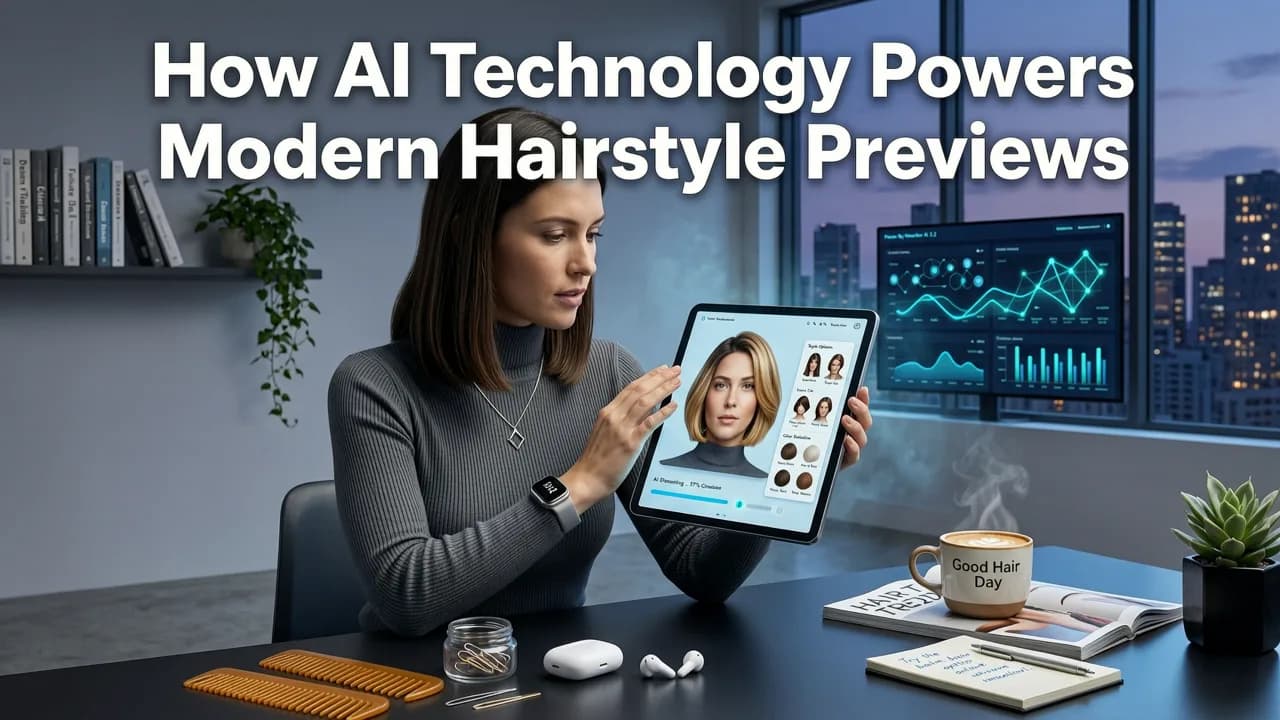
The leap from basic photo editors to sophisticated virtual hair try on platforms is driven by complex computer vision and generative AI. Modern applications do not simply paste a static image of a hairstyle over a selfie. Instead, they analyze the underlying geometry of the face and generate the hair dynamically.

Facial Landmark Detection and Face Shape Analysis
The foundation of any reliable simulation is accurate facial mapping. Advanced algorithms identify dozens of key facial landmarks, including the jawline, cheekbones, forehead width, and chin shape. This data is used to classify the overall face shape—such as oval, square, round, or diamond—which is the primary metric barbers use to recommend flattering cuts.
When an application performs this AI facial mapping, it ensures that the suggested styles complement the user's natural proportions. For a deeper dive into how this technology categorizes features to recommend the most flattering cuts, you can explore resources on the AI face shape hairstyle finder. This level of analysis ensures that a style chosen in the app will translate accurately to the barber's chair.
Hairline Mapping and Texture Blending
Once the face is mapped, the AI must accurately detect the existing hairline, parting, and current hair volume. This is crucial for men, as receding hairlines or specific widow's peaks require tailored styling approaches. The software uses depth estimation to understand the three-dimensional curvature of the head.
Modern generative models, which build upon the foundational research detailed in platforms like the OpenAI documentation for image synthesis, render individual hair strands rather than solid blocks of color. This allows for realistic texture blending, ensuring that the simulated hair interacts naturally with the user's skin tone, existing hair, and the ambient lighting of the original photograph.
Key Features to Look for in a Men's Grooming App
Not all grooming applications are built with the same level of sophistication. When evaluating men's grooming technology, it is important to look for specific features that address the unique aspects of male hair and facial hair.
Comprehensive Beard Filters
Facial hair requires a different rendering approach than scalp hair. A beard interacts with the jawline, neck, and cheeks in complex ways. A high-quality beard style simulator must account for skin texture, pore visibility, and the natural growth patterns of facial hair.
The most effective tools use realistic AI beard try on capabilities to simulate everything from heavy stubble to full, shaped beards. These filters adjust the opacity and density of the hair to match the user's natural complexion, preventing the "painted on" look that plagued older applications. Understanding how these filters adjust to facial contours is critical for previewing styles like the corporate beard, goatee, or full lumberjack look.
Realistic Hair Color Simulation
Men's hair color trends have expanded significantly, with many opting for subtle gray blending, silver fox transformations, or bold fashion colors. However, predicting how a specific dye shade will react to existing hair pigment is notoriously difficult.
A dedicated hair color changer uses strand-level rendering to simulate how light reflects off dyed hair. It accounts for the base color of the user's hair and the target shade, providing a highly accurate preview of the final result. This is particularly useful for men looking to cover gray hairs or experiment with highlights without the commitment of permanent chemical processing.
Comparing Core AI Grooming Technologies
To understand the value of modern applications, it is helpful to compare them against older methods of virtual styling. The following table outlines the technological differences between traditional apps and current AI-driven platforms.
| Feature Category | Traditional 2D Overlay Apps | Advanced AI Rendering (2026) |
|---|---|---|
| Face Mapping | Manual placement and resizing | Automatic 3D landmark detection and depth estimation |
| Hair Texture | Flat, static image blocks | Dynamic strand-level generation and lighting adaptation |
| Beard SimulationSimple opacity overlays | Skin-aware rendering with natural growth pattern mapping | |
| Color Blending | Uniform color tinting | Pigment-aware simulation accounting for base hair color |
| Style Recommendations | Manual browsing through catalogs | Automated suggestions based on analyzed face shape |
How to Get the Best Results from Your AI Try-On
Even the most sophisticated algorithms require high-quality input data to generate accurate outputs. To ensure the most realistic preview, users should follow specific guidelines when capturing their reference selfie.
- Optimal Lighting: Use soft, even, natural lighting. Avoid harsh overhead shadows or direct sunlight, which can confuse the AI's depth estimation and texture blending.
- Neutral Expression: Maintain a relaxed, neutral facial expression. Smiling or frowning alters the position of the jawline and cheeks, which can skew the face shape analysis.
- Clear Hairline: Ensure the hair is pulled back or styled in a way that clearly exposes the natural hairline and forehead. This allows the algorithm to accurately map the starting point for new styles.
- Direct Angle: Face the camera directly. Profile shots or extreme angles can distort facial proportions and lead to inaccurate style recommendations.
By providing a clean, well-lit, and properly angled baseline image, the software can perform its analysis with maximum precision, resulting in a preview that closely mirrors the final physical outcome.
Responsible AI and Ethical Rendering
As artificial intelligence becomes more integrated into daily grooming routines, the importance of responsible development cannot be overstated. Early AI models often struggled with bias, frequently failing to accurately render diverse hair textures or appropriately map features across different ethnicities.
Leading developers now prioritize inclusive datasets and ethical rendering practices. Following frameworks similar to the Google AI guidance on responsible innovation, modern applications are trained on vast, diverse datasets. This ensures that the AI accurately simulates straight, wavy, curly, and coily hair textures, and correctly maps styles onto a wide variety of face shapes and skin tones. This commitment to inclusivity ensures that the technology is genuinely useful and accurate for all users, regardless of their genetic background.
The Future of AI in Men's Grooming
The integration of artificial intelligence into personal grooming is just beginning. As processing power increases and algorithms become more refined, the line between digital simulation and physical reality will continue to blur. Future iterations of these tools may incorporate real-time augmented reality via smart glasses, allowing users to see a new hairstyle or beard style moving naturally in a mirror before the barber even picks up the clippers.
For now, however, the best ai hairstyle app for men remains an invaluable digital consultation tool. By leveraging advanced facial mapping, realistic texture blending, and comprehensive style catalogs, these applications empower men to make informed, confident grooming decisions. Whether planning a subtle trim, a complete color transformation, or a full beard overhaul, the technology ensures that the final result in the mirror matches the vision in your mind.
Ready to explore how artificial intelligence can transform your grooming routine? Discover more about the technology behind realistic previews and find your next great look by exploring the comprehensive guides and tools available on hairstylestryon.com.


