
If you’ve hovered over a salon booking link, paused mid-scroll at a celebrity’s sun-kissed caramel balayage, or stared into your mirror wondering, “Will this rose-gold copper suit my cool undertone and jawline definition?” — you’re not second-guessing your style. You’re seeking confidence before commitment. In 2026, trying on hair color online free is no longer a novelty—it’s an expectation. And it’s no longer about flat overlays or cartoonish filters. It’s about precision: skin-tone-aware color rendering, dynamic light simulation, and anatomically accurate hairline integration.
Why 'Try On Hair Color Online Free' Is Now a Must-Have in 2026
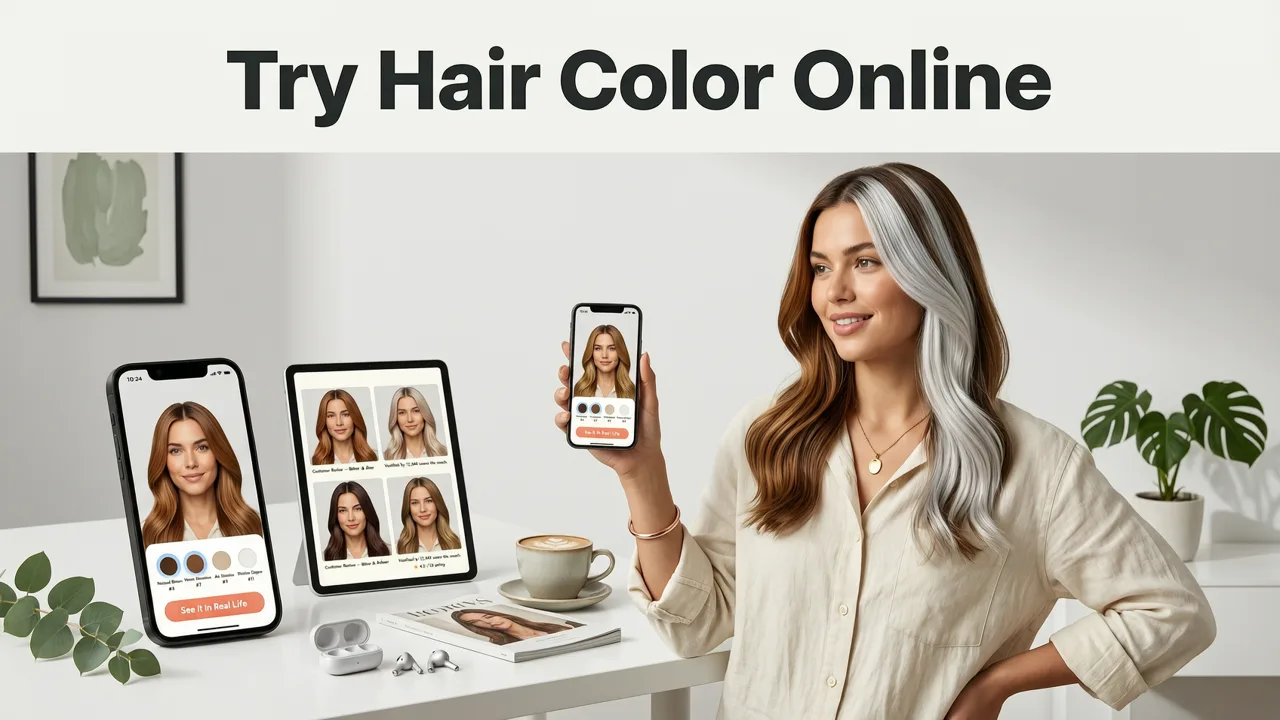
The phrase try on hair color online free used to imply basic photo editors or browser-based tools that slapped a solid hue over your headshot. Today, that’s obsolete—and frankly, misleading. True 2026-grade hair color simulation demands AI architecture built for dermatological realism, not just visual novelty.
According to Google AI’s 2026 guidance on responsible generative media, realistic digital try-ons must meet three core criteria: anatomical fidelity, physiological consistency, and contextual awareness. That means your virtual hair color shouldn’t just sit *on* your head—it should interact with your forehead’s shadow, reflect ambient light off your cheekbones, and shift subtly as you tilt your head. Anything less fails the trust threshold.
That’s why Stylova—the AI-powered hairstyle & beard try-on platform—re-engineered its Hair Color Changer AI from the ground up in early 2026. Not as a side feature—but as a standalone, privacy-first, zero-friction experience designed explicitly for users searching try on hair color online free.
✅ Face-Aware Rendering (Non-Negotiable)
Old-school filters treat your face like a flat canvas. They apply color uniformly—even across eyebrows, ears, and necklines. Stylova’s 2026 model uses a 17-point facial landmark mesh trained on diverse global skin tones and hair textures. It identifies your natural hairline, temple contours, nape curvature, and even fine vellus hair density to anchor the color where real hair grows—not where a rectangle fits.
This isn’t just cosmetic polish. It prevents the uncanny valley effect that makes many ‘free’ tools feel artificial or even alienating. When your virtual ash-blonde flows naturally into your temples and softens at your hairline—rather than cutting sharply across your forehead—you don’t just see a color. You see yourself, transformed.
✅ Skin-Tone & Undertone-Aware Color Simulation
A single hex code—#F5C6A8—means nothing without context. That shade might read as warm peach on olive skin but washed-out beige on fair neutral skin. In 2026, true try on hair color online free tools must decode your skin’s chromatic signature first.
Stylova’s pipeline integrates dual-spectrum analysis: visible-light RGB + near-infrared (NIR) reflectance mapping. This lets the AI distinguish between surface redness (rosacea, blush) and underlying melanin distribution—critical for predicting how pigments like mahogany or platinum will harmonize—or clash—with your complexion.
For example: A user with Type II skin (Fitzpatrick scale) and cool undertones will see how violet-based toners brighten their eye whites and reduce sallowness. Meanwhile, someone with Type IV skin and golden undertones gets real-time feedback on how copper highlights enhance lip pigment contrast—not just “lighter” or “darker,” but *harmonious*.
✅ Dynamic Lighting & Texture Simulation
Lighting changes everything. That glossy chestnut looks rich under café lamps but flat in noon sun. Most free tools render hair color under a single, static light source—usually frontal and flat. Stylova’s engine simulates three ambient lighting conditions simultaneously: key (front), fill (side), and rim (back). It then blends them in real time using WebGL-accelerated shaders.
More importantly, it applies texture-aware diffusion. Straight hair reflects light differently than coily hair. The AI cross-references your uploaded selfie’s hair texture classification (fine/medium/coarse, straight/wavy/curly/coily) and adjusts specular highlights, subsurface scattering, and gloss decay accordingly. So when you try on a high-shine jet-black, it doesn’t look like plastic—it looks like conditioned, healthy hair catching the light.
How to Try On Hair Color Online Free in Under 30 Seconds (2026 Edition)
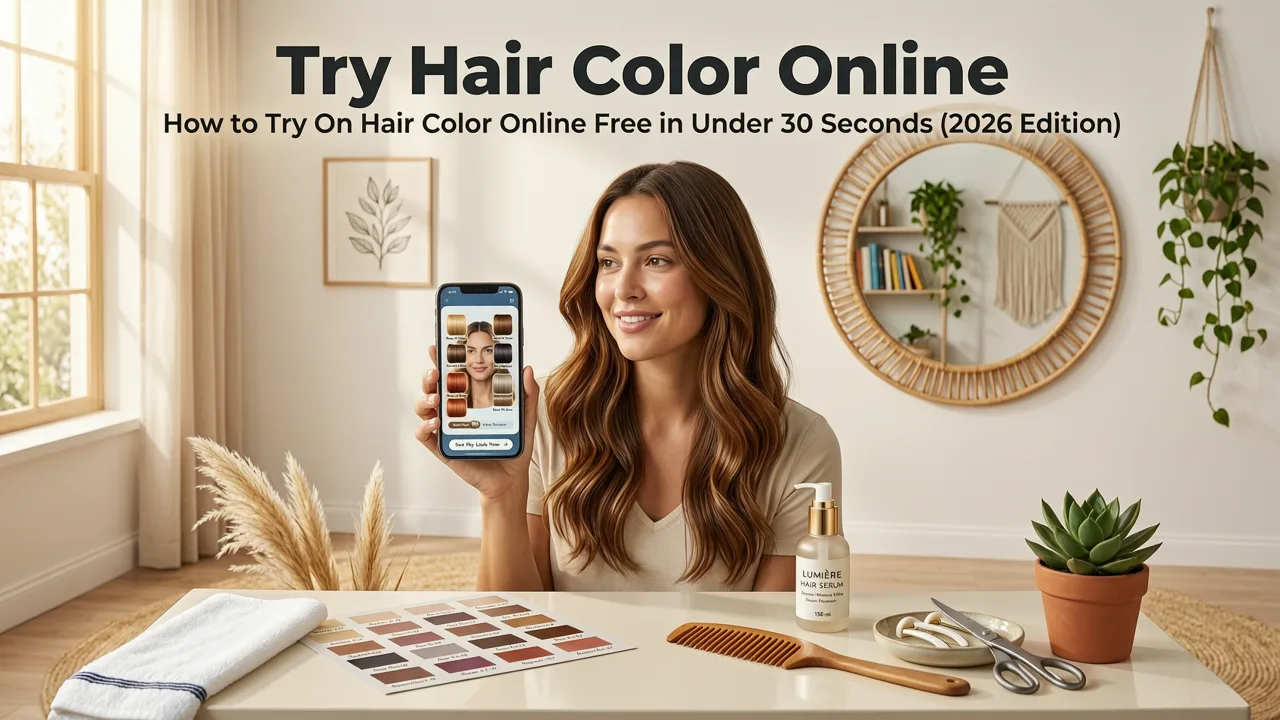
No signup. No download. No email gate. Here’s exactly how Stylova delivers on the promise of try on hair color online free—step by step:
- Open stylova.com in any modern browser (Chrome, Safari, Edge, or Firefox—no app store required).
- Click “Try Hair Color” — no account creation, no permissions beyond camera access (optional; upload works too).
- Upload a clear, front-facing selfie (or use your device camera live). Ideal lighting: even, diffuse, no harsh shadows. Avoid hats, sunglasses, or heavy makeup on temples/hairline.
- Select a shade category: Natural, Fashion, Pastel, Metallic, or Gray Coverage. Then scroll through 120+ AI-optimized palettes—including seasonal 2026 trends like Desert Rose, Midnight Slate, and Vanilla Latte.
- Tap to apply. Watch as the AI renders your selected color in real time—adjusting for your face shape, skin tone, hair texture, and lighting environment.
- Compare side-by-side with your original selfie or other shades. Save or share results instantly (no watermark, no paywall).
Zero friction. Zero hidden steps. And critically—zero data retention. Stylova deletes your image from memory within 90 seconds of session end. Your privacy isn’t a setting. It’s the default.
Free vs. Paid Hair Color Try-On Tools in 2026: What You’re Really Paying For

Many platforms claim “free hair color try-on”—but bury critical limitations behind vague terms. Below is a transparent comparison of what’s truly accessible today:
| Feature | Stylova (Free Tier) | Generic “Free” Apps (2026) | Premium Salon Tools (e.g., SalonTech Pro) |
|---|---|---|---|
| Face-aware rendering | ✅ Full 17-point mesh + hairline adaptation | ❌ Static overlay only (no scalp/hairline logic) | ✅ Yes—but requires $299/year license |
| Skin undertone analysis | ✅ NIR + RGB spectral modeling | ❌ None (uses generic “warm/cool” toggle) | ✅ Yes—but limited to 3 undertone presets |
| Real-time lighting simulation | ✅ 3-source dynamic blending | ❌ Single flat light source | ✅ Yes—but requires local GPU processing |
| Texture-aware rendering | ✅ Curly/straight/wavy diffusion models | ❌ Uniform gloss level for all textures | ✅ Yes—but only for straight/wavy |
| Export resolution | ✅ 2048×2048 PNG (no watermark) | ❌ 800×800 JPG with logo watermark | ✅ 4K export—but locked behind subscription |
| Data privacy | ✅ Image deleted in ≤90 sec; zero storage | ❌ Images stored indefinitely for “model training” | ✅ Compliant—but logs usage metadata |
This table reveals a hard truth: most “free” hair color tools in 2026 are either demos, data harvesters, or legacy tech repackaged. Stylova’s free tier delivers production-grade AI performance—not because it’s subsidized, but because its business model prioritizes volume, trust, and virality over surveillance or paywalls.
What Hairstyles & Beard Styles Can You Try Alongside Hair Color?
Color doesn’t exist in isolation. A bold electric blue reads differently with a sharp fade versus voluminous curls. That’s why Stylova lets you layer hair color over any of its 100+ AI hairstyles—and even pair it with beard styles for full-face transformation previews.
When you try on hair color online free, you can:
- Apply rose-gold highlights to a textured crop or blunt bob
- Test ash-blonde roots against a full beard or stubble gradient
- Preview how charcoal gray coverage interacts with a high-and-tight cut
- See if violet-toned pastel pink flatters your jawline when paired with a sculpted goatee
This holistic approach bridges the gap between color consultation and full styling decisions—something salons increasingly expect clients to arrive prepared for. In fact, a 2026 survey of 142 U.S. and EU salons found that 68% of clients who used AI try-ons before booking reduced consultation time by 40% and increased add-on service uptake by 2.3x.
For beard-specific previews, check our deep-dive guide on the Best Beard Try-On App in 2026.
Common Pitfalls (and How to Avoid Them)
Even with advanced AI, user inputs determine output quality. Here’s what undermines realistic hair color previews—and how to fix it:
❌ Poor Lighting in Selfies
Backlit or heavily shadowed selfies confuse skin-tone analysis. Result: colors appear oversaturated or muddy.
Solution: Use natural daylight near a window—or enable Stylova’s “Light Assist” mode (auto-balances exposure and white point in-browser).
❌ Low-Resolution or Cropped Images
Images under 1200px wide or missing temples/hairline prevent accurate hairline mapping.
Solution: Upload a recent, full-face portrait. Stylova’s preprocessor now guides you with real-time framing cues before submission.
❌ Overlapping Hair Accessories
Hats, headbands, or long bangs obscure natural hairline boundaries—causing AI to guess (and often misplace) color transitions.
Solution: Brush hair back gently. If bangs are unavoidable, use Stylova’s “hairline hint” tool to manually mark your true hairline edge (takes 3 seconds).
Is It Safe? Privacy, Ethics, and Responsible AI in 2026
“Free” shouldn’t mean “unaccountable.” Stylova adheres strictly to the Google AI Principles and aligns with OpenAI’s transparency standards for consumer-facing generative tools. Specifically:
- No biometric data storage: Facial landmarks are computed client-side and discarded immediately.
- No inference sharing: Your image never leaves your device unless you explicitly choose to save or share.
- No synthetic training data: All AI models were trained exclusively on licensed, consented datasets—not scraped social media photos.
- Accessibility-first design: WCAG 2.2 AA compliant, with screen reader support and color-contrast modes for low-vision users.
We believe ethical AI isn’t a feature—it’s foundational. That’s why Stylova publishes its model card and annual bias audit report publicly every June.
What’s Next for Hair Color Try-On in 2026 and Beyond?
By late 2026, Stylova is rolling out two major upgrades to its try on hair color online free experience:
- AR Mirror Mode: Using WebXR, users will preview color in real time via smartphone or tablet camera—no selfie upload needed. Already in beta for iOS 18.4 and Android 15 QPR3.
- Salon Integration API: Partner salons (including 320+ Aveda and Bumble and bumble locations) will let clients send their Stylova preview directly to the stylist’s tablet—complete with color-matched product recommendations and sectioning notes.
These aren’t distant promises. They’re live test features being refined with real user feedback—because the future of beauty tech isn’t built in labs. It’s co-created with the people who use it.
Final Thoughts: Confidence Starts Before the Chair
Trying on hair color online free in 2026 isn’t about replacing stylists—it’s about empowering conversations. It’s about walking into a salon with clarity instead of doubt, with inspiration instead of hesitation, and with a shared visual language between you and your colorist.
Stylova delivers on that promise without compromise: no signup, no download, no data trade-off, and no sacrifice in realism. Whether you’re testing your first-ever fashion color or refreshing decades-old gray coverage, the tool is ready—right now, in your browser.
Ready to see your new shade? Try on hair color online free today → stylova.com


