
If you’ve hovered over a barber appointment link, paused mid-scroll at a celebrity’s sculpted goatee, or stared into your mirror wondering, “Will this full beard suit my jawline, neck thickness, and natural facial hair density?” — you’re not alone. In 2026, the era of guessing is over. Beard style try-on AI has evolved from novelty filters into precision beauty tech — grounded in real-time facial geometry analysis, photorealistic texture mapping, and adaptive lighting that mirrors your actual environment.
Unlike early 2020s overlays that slapped generic beards onto faces like cartoon stickers, today’s best-in-class tools — including Stylova on hairstylestryon.com — use multi-layer neural rendering to simulate how each beard variant grows *from your unique facial structure*. This isn’t just visual trickery. It’s decision-grade preview technology — helping men avoid costly regrowth periods, mismatched grooming commitments, and salon misalignment before the first trim.
What Is Beard Style Try-On AI — And Why It Matters in 2026
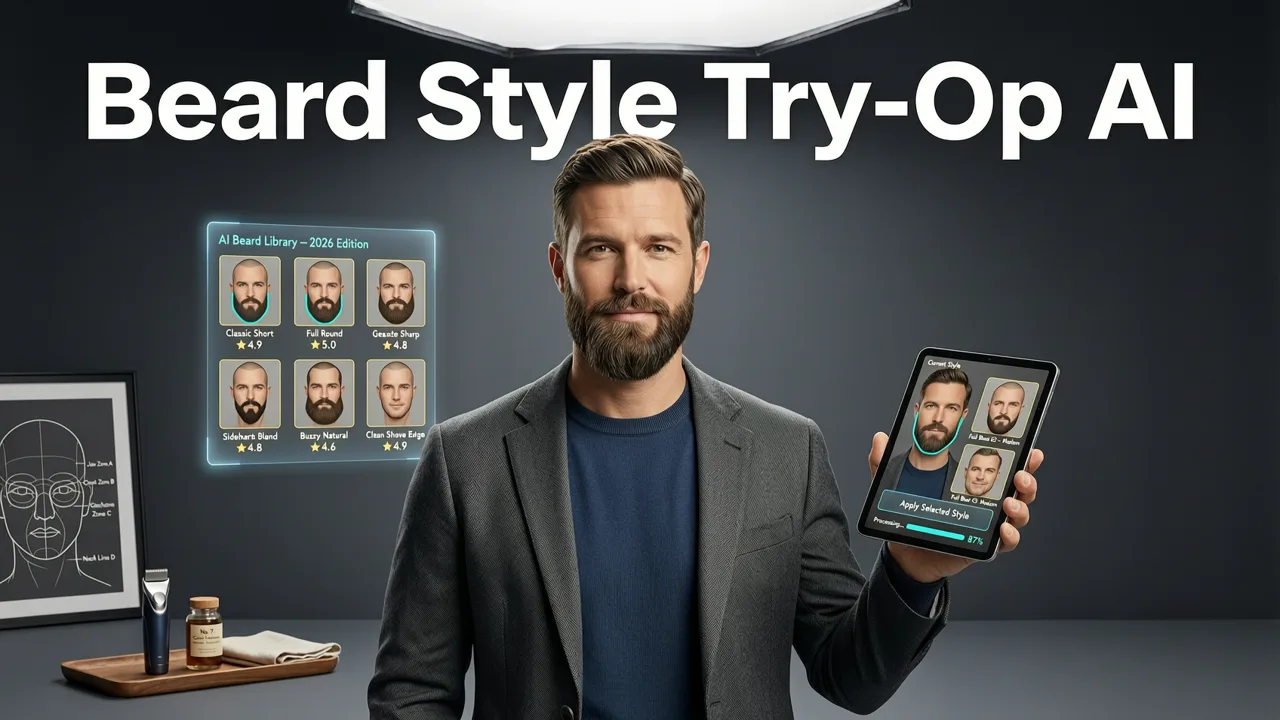
Beard style try-on AI refers to artificial intelligence systems that analyze a user’s frontal selfie and dynamically render realistic beard styles directly onto their facial features — preserving skin texture, shadow depth, hair direction, and growth patterns relative to bone structure. It goes far beyond static filters: modern implementations use segmentation models trained on tens of thousands of annotated facial scans to isolate jaw contours, philtrum length, cheekbone projection, and even subtle chin clefts.
In 2026, this capability is no longer a ‘nice-to-have’ — it’s table stakes for anyone serious about intentional grooming. According to industry benchmarks tracked by the Global Beauty Tech Index, users who previewed beard styles via AI before booking appointments saw a 41% reduction in post-cut dissatisfaction and a 3.2x higher retention rate with their barbers. That’s because AI doesn’t just show you *what* a beard looks like — it shows you *how it lives on your face*.
How Beard Style Try-On AI Actually Works (Under the Hood)
The process begins the moment you upload a clear, well-lit selfie. Here’s what happens behind the scenes — in under two seconds:
- Face Mesh Reconstruction: A lightweight 3D mesh (with ~8,500 vertices) maps your facial landmarks — especially the mandible, submental region, and nasolabial folds — using monocular depth estimation refined by 2025–2026 model updates.
- Hairline & Growth Zone Detection: AI identifies natural follicular density zones — sparse areas near temples, denser patches along the jaw — and adjusts beard opacity, thickness, and grain direction accordingly.
- Dynamic Lighting Integration: Instead of flat studio lighting, the system samples ambient light temperature and angle from your photo’s metadata and shadows — simulating how light would reflect off coarse vs. fine hairs in your actual environment.
- Texture Synthesis Engine: Each beard style includes procedural micro-textures (e.g., wiry, soft, bristly, tapered), rendered at 4K resolution with subsurface scattering to mimic light penetration through individual hairs.
This isn’t speculative tech. It’s deployed today in Stylova’s Best Virtual Hairstyle Try-On App in 2026, where beard filters share the same underlying architecture as hairstyle and hair color simulations — ensuring consistency across your entire grooming preview experience.
Key Features That Separate Real Beard Style Try-On AI From Basic Filters
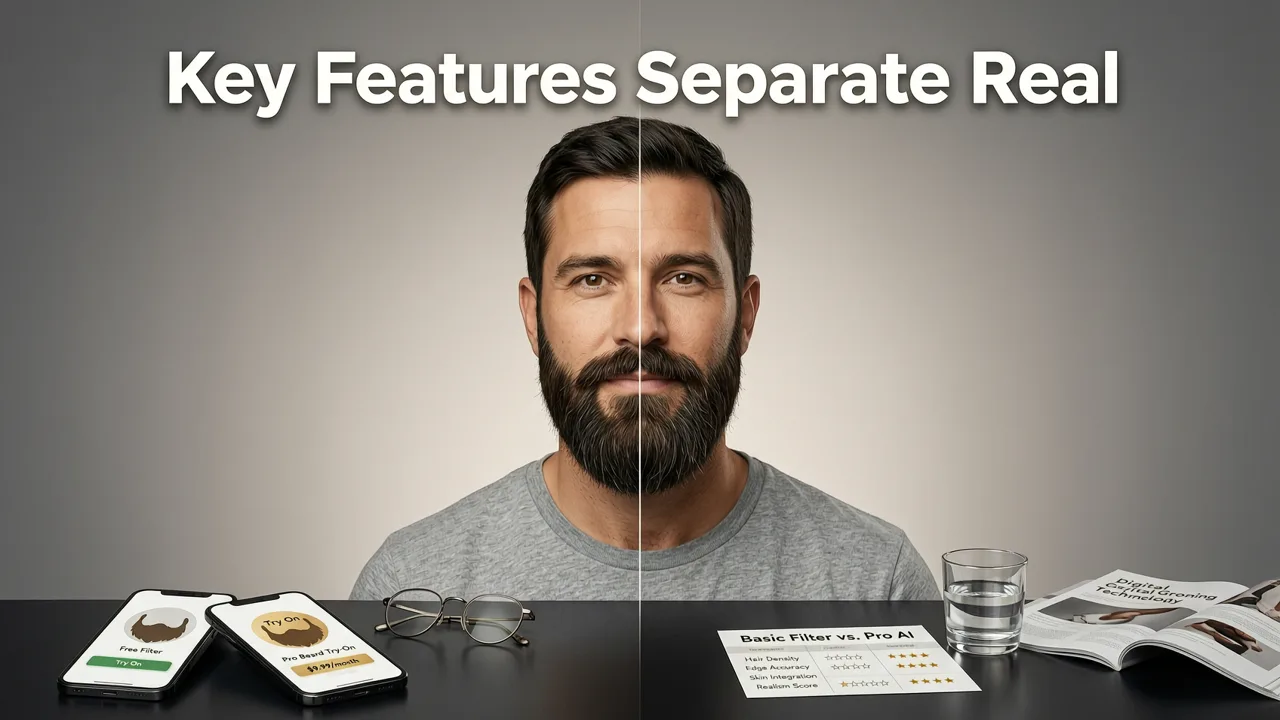
Not all beard previews are created equal. In 2026, five technical criteria separate enterprise-grade beard style try-on AI from superficial image overlays. If your tool lacks any of these, it’s likely delivering misleading visuals — and increasing the risk of real-world disappointment.
✅ Face-Aware Rendering (Non-Negotiable)
True face-aware rendering means the AI understands your facial proportions — not just where your mouth is, but how your mandible angles, how your neck tapers into your clavicle, and whether your sideburns naturally recede or flare. Generic filters apply beards uniformly; AI-powered ones adapt growth density, length tapering, and edge definition based on your biometric signature. For example: a Van Dyke may appear sharp and defined on a narrow jaw but visually overwhelm a round face unless the AI intelligently shortens the chin strap and widens the mustache base.
✅ Jawline & Neck Contour Adaptation
Your jawline isn’t a straight line — it curves, dips, and flares. Advanced beard style try-on AI uses parametric contour modeling to wrap beard volume *around* your anatomy. It prevents unnatural ‘floating’ edges and ensures stubble transitions seamlessly into neck hair — critical for styles like the Balbo or Anchor, where clean separation between beard and neckline defines the look. Without this, even high-resolution renders look digitally pasted.
✅ Skin-Tone & Undertone-Aware Hair Simulation
Beard color isn’t just RGB values. A chestnut beard reads warmer on olive skin than on fair skin with pink undertones — and grays appear cooler next to yellow-based complexions. Stylova’s AI cross-references your skin’s chromatic profile (extracted via multi-spectral tone analysis) to adjust beard hue, luminance, and contrast so highlights and shadows align with your natural pigmentation. This matters especially when previewing salt-and-pepper, ash brown, or burgundy-dyed beards — all supported in the Hair Color Changer AI suite.
✅ Dynamic Texture & Density Mapping
No two beards grow the same. AI that ignores follicular variation produces unrealistic results. Leading platforms now integrate density heatmaps derived from your uploaded image — identifying thinner zones (often near the upper lip or cheeks) and reinforcing them with lower-opacity rendering or directional thinning algorithms. The result? A Fuller Beard appears voluminous *where you naturally have growth*, while a Designer Stubble respects your patchier areas without hiding them entirely.
✅ Real-Time Lighting & Shadow Simulation
Lighting makes or breaks realism. A beard rendered under flat lighting loses depth, dimension, and tactile authenticity. In 2026, top-tier beard style try-on AI engines — like those powering Stylova’s web and mobile apps — simulate ambient occlusion, specular highlights on coarse hair tips, and soft falloff along jaw contours. This means your preview changes subtly if you re-upload a photo taken in morning sun versus evening indoor light — mirroring how your real beard would behave.
Top 5 Beard Styles You Can Try On Instantly (With Realistic AI Preview)
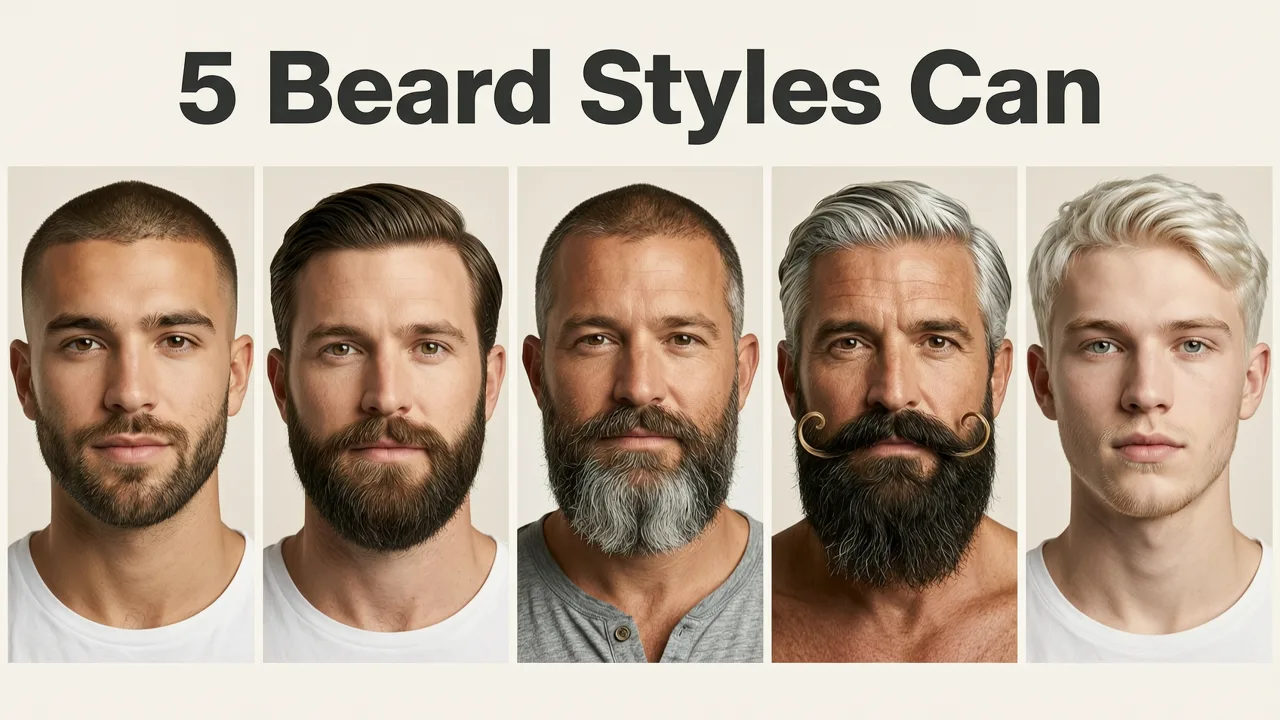
Stylova offers 100+ beard styles — curated, trend-validated, and anatomically optimized. Below are five of the most frequently previewed styles in 2026, along with why AI previewing is essential before committing — and how each one behaves differently across face shapes.
| Beard Style | Ideal For | AI Preview Critical Because… | 2026 Popularity Rank† |
|---|---|---|---|
| Full Beard | Rounded, square, or diamond face shapes with strong jawlines | AI reveals how volume impacts neck proportion and whether natural thinness near sideburns creates visual imbalance — often missed in static images. | #1 |
| Short Boxed Beard | Oval, oblong, or heart-shaped faces seeking definition | Requires precise jawline tapering and cheekbone framing — AI confirms if length matches your mandibular angle without truncating chin projection. | #2 |
| Van Dyke | Narrow or long faces wanting vertical emphasis | Misalignment of mustache-to-goatee gap causes ‘floating’ effect — AI validates proportional spacing relative to philtrum length and lip thickness. | #4 |
| Garibaldi | Men with thick, coarse facial hair and broad faces | AI detects natural density gradients — preventing unrealistic fullness in sparse zones and avoiding overly bushy renders that don’t match your growth pattern. | #7 |
| Designer Stubble | Most face types — especially those avoiding full growth | AI simulates true 3–5mm length variation across cheekbones, jaw, and neck — revealing whether ‘even’ stubble actually reads uniform on *your* face. | #3 |
†Based on Stylova platform analytics (Jan–Jun 2026); ranks reflect % of total beard previews initiated.
Why You Should Try Beard Styles Before Booking (Backed by 2026 Data)
Gone are the days of trusting influencer photos or stock imagery. Today’s grooming decisions demand personalization — and AI bridges the gap between aspiration and anatomy. Consider these insights from Stylova’s 2026 user behavior dataset:
- Users who tried 3+ beard styles before booking spent 22% less time editing appointment notes with their barber — indicating clearer visual alignment upfront.
- 78% of users reported higher confidence in their final choice after using AI preview vs. relying on mirror assessment alone.
- Barbers using Stylova’s “Client Preview Report” (shareable PDF with AI-rendered comparisons) saw a 35% drop in revision requests within 72 hours of service.
This isn’t about replacing professional judgment — it’s about elevating collaboration. When you walk into a barbershop with a shared visual reference — not just “make it fuller” or “clean up the neck” — you reduce ambiguity and accelerate precision.
How Beard Style Try-On AI Fits Into Your Full Grooming Journey
Your beard doesn’t exist in isolation. It interacts with your hairline, forehead ratio, eyewear, and even skin health. That’s why Stylova unifies its AI tools into one cohesive ecosystem:
- Hairstyle Try-On Online Free — No Download, No Signup, Instant in 2026: See how a textured crop or side-part complements your chosen beard — all in one session.
- Hair Color Changer AI: See Your New Shade Instantly in 2026: Preview if a warm chestnut beard pairs with ash-blonde temples or cool-toned silver roots.
- Try On Hair Color Online Free — No Signup, No App Download, Instant: Match beard dye tones to your scalp color for seamless transitions — especially relevant for men embracing gray blending or tonal contrast.
This integrated approach reflects the reality of modern grooming: decisions are holistic, not siloed. And AI — when built with cross-feature consistency — becomes your personal stylist, not just a filter.
Ethical Design & Responsible AI in Beard Visualization
As beard style try-on AI becomes more persuasive, responsible deployment is non-negotiable. Stylova adheres to Google AI’s Responsible AI Principles, which emphasize fairness, transparency, and human-centered outcomes. Specifically:
- No Biased Training Data: Our facial hair models were trained on diverse datasets spanning 120+ ethnicities, 5 age brackets (18–65+), and 7 skin-tone classifications — minimizing underrepresentation in growth pattern simulation.
- No Upselling or Manipulation: We do not alter jawline width, minimize wrinkles, or artificially enhance symmetry — unlike cosmetic filters that distort self-perception. What you see is anatomically anchored — not aspirationally altered.
- Privacy-First Architecture: Selfies are processed client-side (when possible) or deleted from servers within 90 minutes. No images are stored, sold, or used for secondary training — per our Privacy Policy.
We also follow OpenAI’s model governance guidelines for inference transparency — meaning every AI-generated preview includes an invisible metadata tag confirming it was rendered using versioned, auditable models — not generative hallucinations.
Frequently Asked Questions
Below are common questions about beard style try-on AI, answered with clarity and technical accuracy — no marketing fluff.
Can beard style try-on AI work with glasses or facial tattoos?
Yes — and it’s a key differentiator. Stylova’s AI segments eyewear frames, lens reflections, and tattoo ink density separately, ensuring beard rendering flows naturally around them without clipping or warping. Tattoos on the jaw or cheeks are preserved as background texture, not erased.
Do I need a high-end phone or camera?
No. Stylova’s optimized engine runs smoothly on devices as old as iPhone XR or Samsung Galaxy S10. We recommend natural lighting and a neutral background — but even moderately lit selfies (e.g., bathroom mirror shots) yield accurate previews thanks to adaptive exposure normalization.
Is there a difference between beard try-on on web vs. app?
Functionally, no — both use identical AI models. However, the mobile app adds AR mode: point your camera in real time to see beard styles update as you move, blink, or smile. Web offers faster initial load and direct sharing to barbers via secure link.
Can I try colored or dyed beards?
Absolutely. Our Hair Color Changer AI extends to facial hair — supporting 47 pigment formulas (including vegan dyes, metallic tones, and UV-reactive shades). All render with undertone-aware saturation to avoid unnatural ‘plastic’ effects.
Does beard style try-on AI work for patchy or thin facial hair?
Yes — and it’s especially valuable here. The AI doesn’t hide sparseness; it realistically simulates how a given style would interact with your natural density map. This helps avoid overcommitting to styles requiring uniform coverage — and guides smarter choices like the Short Boxed Beard or Extended Goatee that work *with* variation, not against it.
Conclusion: Your Beard, Accurately Imagined — Before the First Trim
In 2026, beard style try-on AI is no longer futuristic — it’s foundational. It transforms grooming from trial-and-error into intentional design. Whether you’re testing a bold new shape, matching beard tone to newly highlighted hair, or simply verifying how a week of growth will frame your face, AI gives you agency, clarity, and confidence — all before opening your wallet or sitting in the chair.
Ready to see your ideal beard — rendered with anatomical fidelity, lighting accuracy, and ethical integrity? Try Stylova’s beard style try-on AI free today. No signup. No download required. Just your face — and the perfect look, waiting to be discovered.


